+1 866 300 9012 contact@measur.ca
CHARIOT

Aucun produit dans le chariot

TOTAL:
$0.00

How Falcon & Swift Geomatics Uses the Trinity Pro to Monitor Oil Sands Infrastructure

 Case Study 

February 24th, 2025                  4 minutes read

Company

Falcon & Swift Geomatics

Drone

Quantum Systems Trinity Pro 

with Sony RX1 RII

Location

Anzac, Alberta

Canada

Application

Survey & Mapping

Oil sands operations cover vast expanses, spanning hundreds of square kilometers, and are typically located in environments that present challenges such as hazardous terrain and harsh weather conditions. Traditional methods of monitoring, such as manned aircraft, or ground-based inspections, can be costly and difficult to deploy on a regular basis in such environments. With the previous challenges in mind, leading geospatial services provider Falcon & Swift Geomatics decided to leverage the Trinity Pro Fixed-Wing VTOL UAV (Unmanned Aerial Vehicle).


Falcon & Swift Geomatics was seeking a drone capable of longer flight times and greater coverage to support BVLOS (beyond visual line-of-sight) operations, a goal that made the Trinity Pro even more attractive. Rated to fly near and over people (a requirement for certain BVLOS operations) the Trinity Pro was the perfect tool.

"We selected the Trinity Pro because of the distance it can cover in 1 battery (100 km in ideal
conditions, ~85 km in our real field conditions)".

Xue Yan Chan

Remote Sensing Specialist at Falcon & Swift Geomatics.

Project Overview

In October 2024, Falcon & Swift Geomatics conducted a mapping project near Anzac, Alberta, focusing on oil sands infrastructure and encroaching vegetation within the boreal forest. The project covered 920 hectares, including 40 kilometers of linear features such as pipelines, saline wells, and well sites. A mix of corridor and area mapping was required to capture the area of interest, characterized by a mosaic of forested upland stands and sparsely treed wetlands.


The team used the Trinity Pro UAV, which enabled efficient mapping with advanced terrain-following capabilities for consistent GSD on undulating terrain. Vertical take-off and landing (VTOL) functionality proved invaluable in the forested environment, allowing operations from tight clearings.

Why the Trinity Pro?

The Trinity Pro's increased VTOL height provided additional safety when operating near 30-meter-tall trees. The project spanned three days, with seven flights conducted in total. Each mission lasted approximately one hour, utilizing one battery. Operations were performed within visual line-of-sight (VLOS), but staging in forested areas presented visibility challenges. To overcome this, the team sought vantage points in sparsely treed wetlands or natural areas of higher relief.


The Trinity Pro's PPK (Post-Processed Kinematic) capabilities played a crucial role in the project's success by delivering highly accurate georeferenced data. This technology significantly reduced the need for ground control points (GCPs), achieving centimeter-level precision while saving time and effort that would have been spent placing GCPs in difficult-to-navigate terrain.


The onboard RGB camera, the Sony RX1RII, further elevated the quality of the data collected. Featuring a 42.4 MP full-frame sensor, the camera provided exceptional resolution and sharpness. Its lightweight design perfectly complemented the Trinity Pro, enhancing flight efficiency and enabling the team to cover the area with fewer missions.

Data Processing Workflow

The collected data underwent a detailed processing workflow to ensure high-quality deliverables:


1. QBase:

• Geotagged images using a PPK workflow for improved positional accuracy; this process utilized GNSS base stations recording raw static data, which were then processed through PPP to get an accurate ground point to PPK the drone data.


2. Pix4Dmapper:

• Conducted initial processing, including keypoint computation, automatic aerial triangulation, and bundle block adjustment.
• Performed point cloud densification.
• Generated an orthomosaic to create a seamless georeferenced map.


3. LAStools and LidR R Package:

• Classified the densified photogrammetry point cloud into categories (e.g., ground, vegetation, etc.).
• Rasterized the point cloud into digital elevation models (DEMs).


"The project was only possible due to the support of the Measur team.
Measur provided the equipment and training that allowed
our team to take the Trinity Pro out to the field and complete this project. They provided
excellent customer service, even providing us assistance via phone call when we were in
the field, ensuring that we could complete the job".

Xue Yan Chan

Remote Sensing Specialist at  Falcon & Swift Geomatics.

Deliverables

Utilizing the Sony RX1RII camera, featuring a 42-megapixel, 35 mm full-frame sensor, Falcon & Swift Geomatics produced the following project deliverables:

  • True-colour orthomosaics at a 2 cm resolution, providing detailed maps.
  • Digital elevation models (DEMs) at a 10 cm resolution, derived from the classified photogrammetry point clouds.

Conclusion

By utilizing the Trinity Pro, Falcon & Swift Geomatics significantly enhanced its oil sands infrastructure monitoring capabilities. The drone's robust performance, including its impressive 90 min flight time, advanced sensor suite, and ability to operate in harsh environments has transformed how geospatial data is captured and analyzed in the energy sector.


The high-resolution orthomosaics created a detailed digital archive of infrastructure and the surrounding landscape, offering a snapshot in time that can be revisited and analyzed repeatedly. This archive supports multitemporal analysis, enabling comparisons across time and providing insights for future challenges or applications. By preserving every detail in a digital format, the data becomes a versatile resource for environmental monitoring, regulatory compliance, and operational planning.

Get in Touch

Give us a call or drop by anytime, we will answer all enquiries within 24 hours on business days. We will be happy to answer your questions.

About the Author

Maria Zavarce, Marketing Coordinator at Measur, brings over three years of specialized experience in the drones and robotics industry. Combining her knowledge of emerging technologies with 8+ years of inbound marketing and SEO, she provides actionable insights into the transformative power of advanced solutions.

YOU MAY ALSO LIKE

Les levés bathymétriques, qui impliquent la cartographie de la topographie sous-marine des lacs, des rivières, des océans et d'autres plans d'eau, ont toujours été menés à l'aide de bateaux habités traditionnels équipés de systèmes sonar. Bien qu’efficaces, ces méthodes peuvent prendre du temps, être coûteuses et parfois risquées, en particulier dans les eaux peu profondes, éloignées ou dangereuses. Cependant, drones ou véhicules aériens sans pilote (UAV) et navires de surface sans pilote (USV) facilitent les levés bathymétriques en offrant une alternative plus rapide, plus efficace et plus sûre.

Qu'est-ce qu'une étude bathymétrique ?

Un levé bathymétrique mesure la profondeur et la topographie de la surface sous-marine, fournissant une carte détaillée du lit de l'eau. Ces enquêtes sont essentielles pour diverses industries, notamment la surveillance environnementale, l'ingénierie côtière, la construction sous-marine et la recherche scientifique. Les méthodes traditionnelles reposent souvent sur des échosondeurs montés sur des bateaux ou des navires, mais les drones offrent désormais de nouvelles possibilités pour la collecte de données bathymétriques.

Types de drones utilisés pour les levés bathymétriques

Il existe deux principaux types de drones utilisés dans les levés bathymétriques, les drones aériens (UAV) et les drones de surface ou USV :

Drones aériens (UAV)

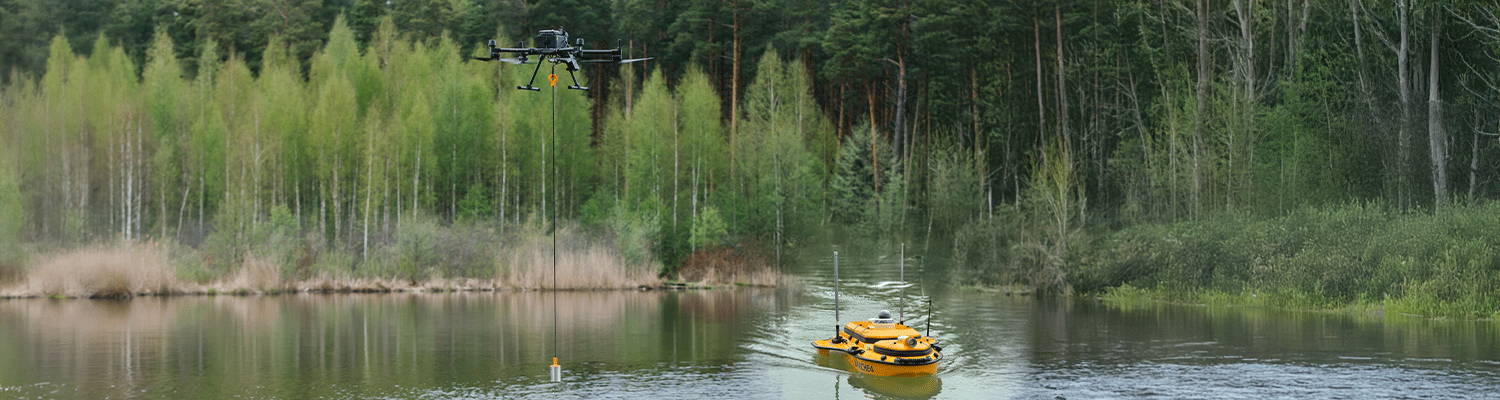
Sondeur écho basé sur un drone
Echosondeur EchoLogger ECT D052S
Ces drones sont généralement utilisés pour collecter des données aériennes ou pour aider au lancement de drones de surface plus petits. Ils peuvent également être équipés de capteurs LiDAR ou de systèmes de photogrammétrie pour cartographier la surface de l’eau. Par exemple, le DJI M350 RTK, peut être équipé d'appareils comme le EchoLogger ECT D052S, un échosondeur double fréquence haute performance qui mesure des profondeurs d'eau comprises entre 0,5 et 200 mètres. Cet échosondeur est équipé de capteurs d'inclinaison et de température et dispose d'une interface RS232, permettant une intégration facile avec les drones. Sa conception légère et durable le rend idéal pour un déploiement dans des environnements difficiles, offrant une collecte de données sous-marines précise pour les plans d'eau de petite à grande échelle. Le échosondeur fournit une solution polyvalente et efficace pour une cartographie sous-marine détaillée sans avoir besoin de navires habités traditionnels.
Oct 01, 2024
RETOUR AU SOMMET